
.NETConf 2025: Key Trends and Takeaways
It’s my favorite time of year — time to put the .NET hat on — because it’s time for .NETConf 2025. Looking back, it’s interesting to see how the focus of the conference has evolved year over year and what that tells us about the direction of the .NET ecosystem.
A Look Back: From Aspire to Modernization
A year ago, the dominant theme was unmistakable: Aspire. It was everywhere. Six months later, the focus shifted toward modernization, with a lot of discussion framed around helping teams modernize existing systems. That period raised many questions, concerns, and contributions from the community, with plenty of people trying to understand where things were heading.
Going into this year, there was a fair amount of skepticism. Expectations were low, and there was a real concern that things might feel awkward or disconnected. However, it’s clear that the feedback landed — and that changes were made.
A Strong Opening and a Familiar Face
This year opened with Scott Hanselman, referencing classic ASP.NET MVC right from the start. For long-time .NET developers, this was unexpectedly refreshing. Compared to last year’s opening, which felt disconnected and confusing to many, this approach immediately grounded the event in familiar territory.
For seasoned developers, this shift alone set a more confident and reassuring tone.
Aspire Still Matters — But Less Dominant
Aspire remains a major pillar of the platform, but it has clearly matured. The platform has now been updated and renamed to Aspire 13, dropping the “.NET Aspire” naming entirely.
The ambition is obvious: Aspire is being positioned as an infrastructure orchestration system capable of appealing even to polyglot teams — environments where C# is only one part of the stack. If Microsoft succeeds here, it would be a significant achievement.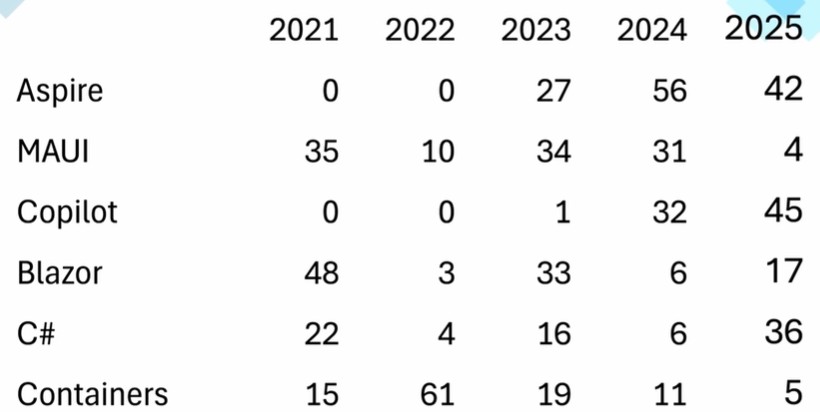
In terms of visibility:
- Aspire was mentioned 42 times during the keynote.
- Last year, it was mentioned 56 times.
That’s a noticeable drop, but it doesn’t signal decline — it signals a redistribution of attention.
Copilot and C# Gain Momentum
The reduced emphasis on Aspire is largely explained by the growing focus on Copilot. Mentions of Copilot increased by roughly 50% compared to last year. At the same time, C# received a solid amount of attention, reinforcing its continued importance at the core of the ecosystem.
Overall, this resulted in a well-balanced keynote that felt more deliberate and better structured than in previous years.
Shifting Trends Across the Stack
When comparing topic mentions over the last four years, several trends stand out:
- Containers continue a slow but steady decline in emphasis.
- Blazor experienced something of a renaissance. Previously thought to be fading, it received a respectable number of mentions this year.
- These numbers aren’t scientific, but they do provide a useful directional signal about Microsoft’s priorities.
The Big Surprise: .NET MAUI
The most striking data point this year was .NET MAUI.
- MAUI was mentioned only four times during the keynote.
- Last year, it was mentioned more than 30 times.
Some will argue that this doesn’t mean MAUI is in trouble — and that may be true. Still, such a dramatic drop is difficult to ignore. Interpret the data however you like, but the shift is undeniable.
Blazor and the End of a Catchphrase
Blazor received 17 mentions, reinforcing its renewed relevance. But perhaps the most astonishing statistic of all was this:
- The word “folks” was mentioned zero times.
Considering how frequently it appeared in previous years, its complete absence is remarkable — and for many, a welcome change.
Visual Studio 2026 Arrives
Another major highlight is the release of Visual Studio 2026. It’s a strong, polished release that delivers serious performance and productivity improvements. Just don’t expect miracles if you’re running it on underpowered hardware — it demands real resources.
Final Thoughts
Overall, .NETConf 2025 felt more grounded, more self-aware, and more aligned with its audience than recent editions. Aspire remains central, Copilot is clearly rising fast, and long-standing technologies like C# and Blazor continue to hold their ground.
The real question now is simple: what will the next year bring for .NET?