
Comparison Between TOON and JSON
This article explores the comparison between TOON and JSON, focusing on their purpose, structure, token efficiency, and usage in modern applications, especially in the context of large language models (LLMs).
What Is TOON?
TOON is a token-oriented object notation designed specifically for AI-based applications. Its primary goal is to reduce token usage when working with LLM prompts and responses. TOON is a compact, human-readable encoding of the JSON data model and is optimized for efficient communication with language models.
TOON was created by Johan Shockplitch, with contributions associated with Jason and Douglas Crockford in the broader JSON ecosystem. As of December 2025, TOON is a relatively new format and is mainly used in AI-driven environments.
What Is JSON?
JSON (JavaScript Object Notation) is an open standard file format and data interchange format. It is widely used for transferring data between systems, representing structured data, storing configuration files, and enabling communication between APIs and services.
JSON is a universal format with broad adoption across platforms, programming languages, and tools.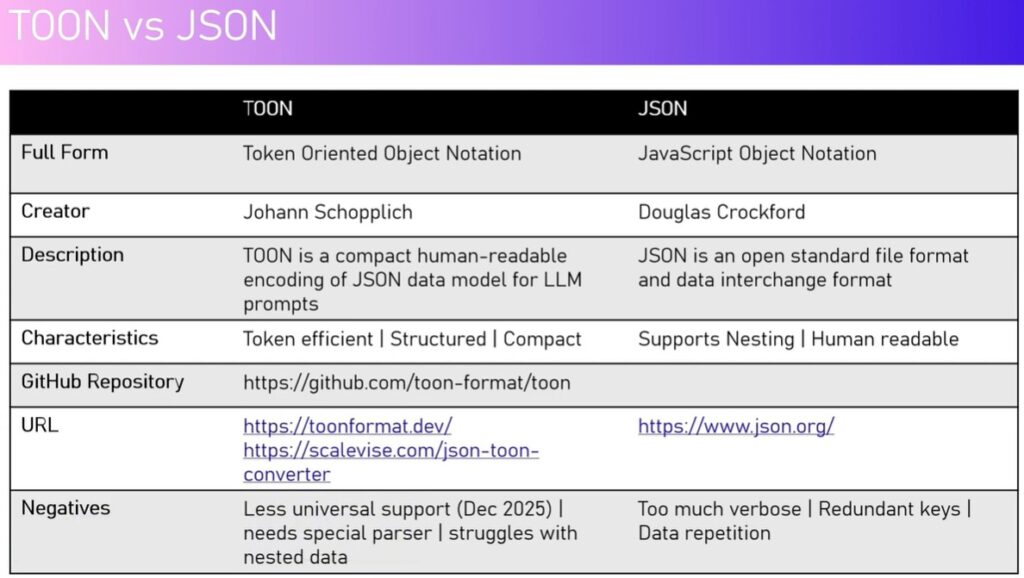
Key Characteristics
TOON Characteristics
-
Token-efficient and optimized for LLM usage
-
Structured and compact
-
Human-readable
-
Supports nesting
-
Designed specifically for AI-based applications
JSON Characteristics
-
Human-readable and easy to understand
-
Supports deeply nested objects
-
Universally adopted and widely supported
-
Suitable for configuration files and data exchange
-
Open standard with mature tooling
Limitations
TOON Limitations
-
Limited universal support as of December 2025
-
Newly introduced and not yet widely known
-
Requires a special parser
-
Can struggle with deeply nested data structures
JSON Limitations
-
Verbose by nature
-
Contains redundant keys
-
Data repetition increases file size and token count
File Extensions
-
TOON uses its own specific format extension
-
JSON files use the
.jsonextension
Usage Comparison
TOON is primarily used for:
-
Token-efficient input to LLMs
-
Token-efficient output from LLMs
-
Passing compact structured data to language models
JSON is primarily used for:
-
Passing data between APIs and services
-
Configuration management
-
General-purpose data representation and interchange
Data Structure Support
-
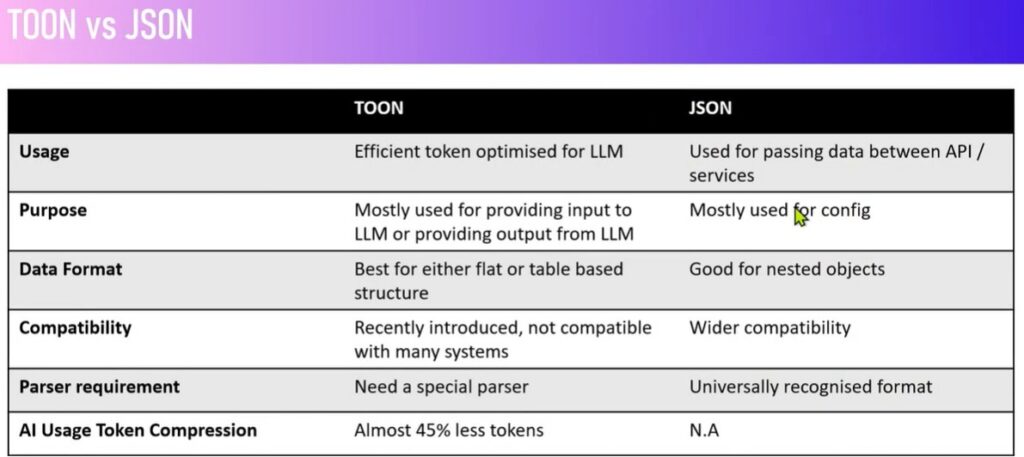
TOON is best suited for flat or table-based structures, though it can support nesting
-
JSON is well-suited for nested and hierarchical objects
Compatibility
-
TOON has limited compatibility due to its recent introduction
-
JSON has wide compatibility across systems, platforms, and tools
Parser Requirements
-
TOON requires a special parser to decode and interpret the format
-
JSON is universally recognized and supported without special parsing requirements
Token Efficiency
From a token usage perspective, TOON provides significant advantages. When comparing equivalent data structures, TOON can reduce token usage by approximately 45% or more. In some benchmarks, reductions of nearly 60% have been observed, depending on the complexity of the data and the LLM being used.
Example Structures
A simple TOON structure may include:
-
A task field
-
A status value
-
A list of steps represented in a compact, array-like format
TOON allows flexible nesting depending on how the data is structured. For example, employee details or task workflows can be represented at a single nesting level or broken into arrays for efficiency.
When compared with JSON, the same data in JSON typically includes repeated keys and deeper nesting, which increases token count. At a high level, JSON structures often contain parent objects such as client or workDetails, each holding multiple fields and nested objects. TOON represents the same information in a more compressed form.
Ecosystem and Resources
JSON documentation provides details about:
-
Its creation and history
-
Valid JSON structures
-
Syntax rules
-
Usage for transferring data across systems
TOON documentation explains:
-
How JSON is encoded into TOON
-
How schema-aware compression works
-
Why a special parser is required
-
How TOON compares with JSON, YAML, XML, compact JSON, and CSV
Some comparisons show token reductions of around 59.8%, with even higher savings for certain LLMs.
There are also community tools and playgrounds that allow:
-
Converting JSON to TOON
-
Loading example datasets
-
Comparing token usage
-
Downloading or copying the TOON output
-
Viewing token savings in real time
For example, a simple JSON structure with 59 tokens may be reduced to 24 tokens in TOON, saving over 59%. More complex JSON structures can achieve even higher compression ratios.
Conclusion
TOON and JSON serve different purposes. JSON remains the universal standard for data interchange, configuration, and API communication. TOON, on the other hand, is a specialized format designed for efficiency in AI and LLM-based workflows.
While TOON offers significant token savings and compact representation, its limited adoption and requirement for special parsers mean it currently complements JSON rather than replacing it. As AI-driven applications continue to grow, TOON may gain wider adoption, especially in scenarios where token efficiency is critical.